NASA
NASA Science
Mars Exploration Program
Skip Navigation
menu
Images
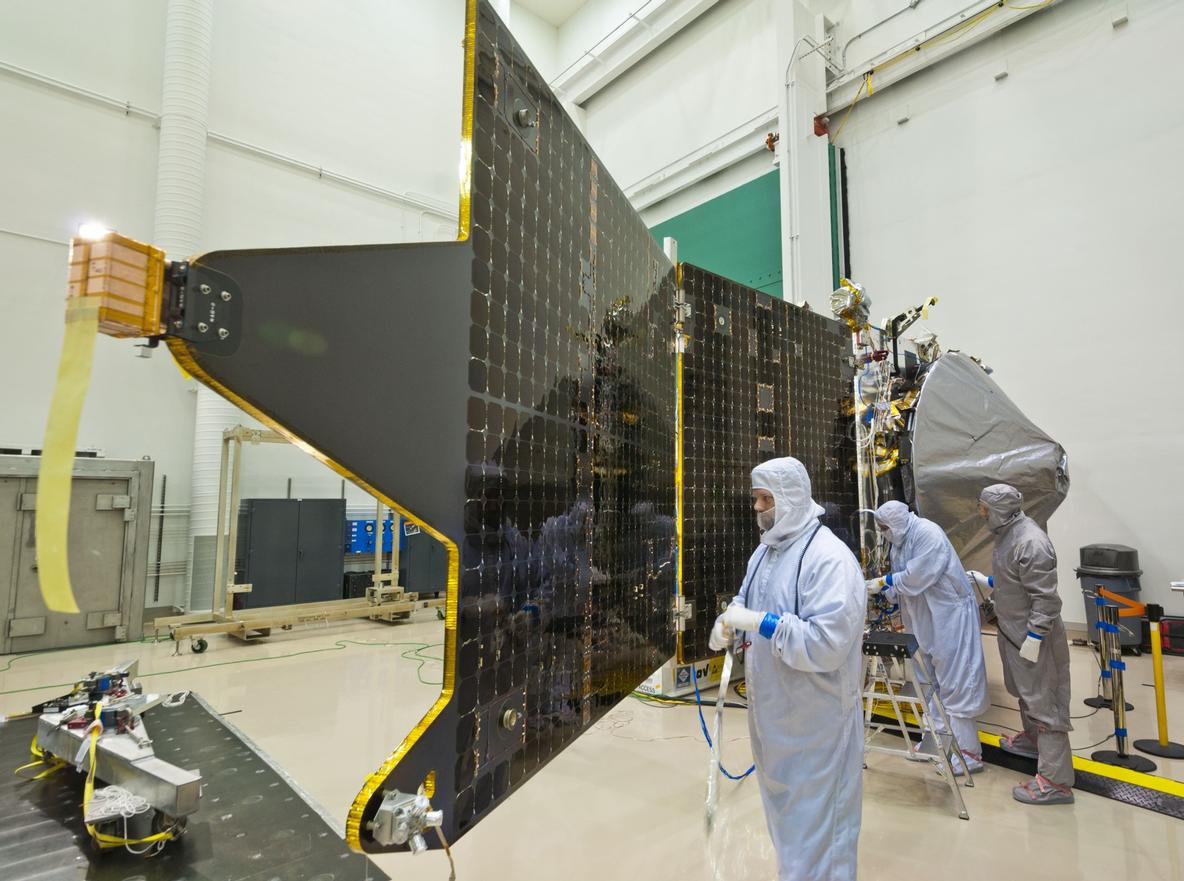
MAVEN Solar Panel
February 08, 2013
Credits
Courtesy Lockheed Martin
ENLARGE
[51, 181]
Related
Image of MAVEN spacecraft, annotated to identify instruments
MAVEN Instrument Panel
The Solar Wind Electron Analyzer (SWEA) is a part of the Particles and Fields (P & F) Package and will measure the solar wind and ionospheric electrons.
Solar Wind Electron Analyzer for MAVEN Spacecraft
Mars is experiencing large regional dust storms over its northern hemisphere during the past week.
The Martian Dust Storm of June 2018
The engineering model of the Extreme Ultraviolet (EUV) sensor that is part of the Langmuir Probe and Waves (LPW)/EUV experiment on MAVEN and will measure the solar EUV input to the atmosphere.
MAVEN Extreme Ultraviolet Sensor
At Cape Canaveral Air Force Station in Florida, the United Launch Alliance Atlas V first stage is lifted for stacking at Launch Pad 41 in preparation for the Mars Atmosphere and Volatile Evolution,...
MAVEN's Atlas V Lifted to Launch Pad
The payload fairing for the Mars Atmosphere and Volatile Evolution, or MAVEN, spacecraft arrives at the Payload Hazardous Servicing Facility at NASA's Kennedy Space Center in Florida.
MAVEN's Payload Fairing Arrives
This artist's concept depicts NASA's Mars Atmosphere and Volatile EvolutioN (MAVEN) spacecraft orbiting Mars.
MAVEN Orbiting Mars
This artist's concept shows the MAVEN spacecraft in orbit around the Red Planet, with a fanciful image of her home planet in the background.
MAVEN to Mars
The Solar Wind Electron Analyzer, shown here before being delivered to Lockheed Martin for integration with the MAVEN spacecraft.
MAVEN Solar Wind Electron Analyzer
Inside the Payload Hazardous Servicing Facility at NASA's Kennedy Space Center in Florida, engineers and technicians test deploy the twin solar arrays on the Mars Atmosphere and Volatile Evolution,...
MAVEN Solar Arrays Tested
This artist's concept depicts the early Martian environment (right) - believed to contain liquid water and a thicker atmosphere - versus the cold, dry environment seen at Mars today (left).
The Look of a Young Mars
NASA's MAVEN mission is observing the upper atmosphere of Mars to help understand climate change on the planet. MAVEN entered its science phase on Nov. 16, 2014.
MAVEN at the Limb of Mars, Artist's Concept
This image is a stereo, panoramic view of various trenches dug by NASA's Phoenix Mars Lander. The images that make up this panorama were taken by Phoenix's Surface Stereo Imager at about 4 p.m., lo...
Phoenix Trenches (3-D)
MAVEN was launched into a Hohmann Transfer Orbit with periapsis at Earth’s orbit and apoapsis at the distance of the orbit of Mars. The spacecraft will travel more than 180 degrees around the Sun i...
Hohmann Transfer Orbit
For optimal performance, it’s important for the high-gain antenna to maintain a consistent temperature while the spacecraft experiences large temperature swings from being exposed to the Sun or in ...
MAVEN High-Gain Antenna WIth Radome
NASA's MAVEN (Mars Atmosphere and Volatile EvolutioN) spacecraft, inside a payload fairing, is hoisted to the top of a United Launch Alliance Atlas V rocket at the Vertical Integration Facility at ...
MAVEN Spacecraft Positioned Atop Atlas V Rocket
MAVEN Launches.
MAVEN Launches
A transporter moves NASA's MAVEN spacecraft, inside a payload fairing, to the Vertical Integration Facility at Launch Complex 41 where it will be hoisted atop a United Launch Alliance Atlas V rocke...
MAVEN Arrives at Launch Pad
NASA’s MAVEN (Mars Atmosphere and Volatile EvolutioN) mission acquired stunning views of Mars in two ultraviolet images taken at different points along our neighboring planet’s orbit around the Sun.
MAVEN Spacecraft Stuns with Ultraviolet Views of Red Planet
Mars’ nightside atmosphere glows and pulsates in this data animation from MAVEN spacecraft observations. Green-to-white false color shows the enhanced brightenings on Mars’ ultraviolet “nightglow" ...
Mars Nightglow Animation from MAVEN Observations
Conceptual image of wind (blue arrows) flowing over rugged Martian terrain and generating disturbances that propagate upward as atmospheric gravity waves (grey lines).
Artist's Concept of Wind Flowing over Martian Terrain
The United Launch Alliance Atlas V rocket lifts off from Space Launch Complex-41 at Cape Canaveral Air Force Station carrying the Mars Atmosphere and Volatile Evolution, or MAVEN, spacecraft on a 1...
MAVEN on Its Way
The MAVEN Electra UHF Transceiver Flight Model is shown here.
MAVEN Electra UHF
The diagram explains the cause of Mars’ glowing nightside atmosphere.
Diagram of Mars' Glowing Nightside
This image of the Mars night side shows ultraviolet emission from nitric oxide (abbreviated NO)
Mars' Nightside Atmosphere
You Might Also Like
The agency established the board in May 2023 to evaluate the technical, cost, and schedule plans prior to confirmation of the mission’s design.
NASA Releases Independent Review's Mars Sample Return Report
A pair of quakes in 2021 sent seismic waves deep into the Red Planet’s core, giving scientists the best data yet on its size and composition.
NASA InSight Study Provides Clearest Look Ever at Martian Core
Ten sample tubes, capturing an amazing variety of Martian geology, have been deposited on Mars’ surface so they could be studied on Earth in the future.
NASA's Perseverance Rover Completes Mars Sample Depot
Filled with rock, the sample tube will be one of 10 forming a depot of tubes that could be considered for a journey to Earth by the Mars Sample Return campaign.
NASA's Perseverance Rover Deposits First Sample on Mars Surface
The mission has concluded that the solar-powered lander has run out of energy after more than four years on the Red Planet.
NASA Retires InSight Mars Lander Mission After Years of Science
The 10 sample tubes being dropped on Mars’ surface so they can be studied on Earth in the future carry an amazing diversity of Red Planet geology.
NASA's Perseverance Rover to Begin Building Martian Sample Depot