NASA
NASA Science
Mars Exploration Program
Skip Navigation
menu
Images
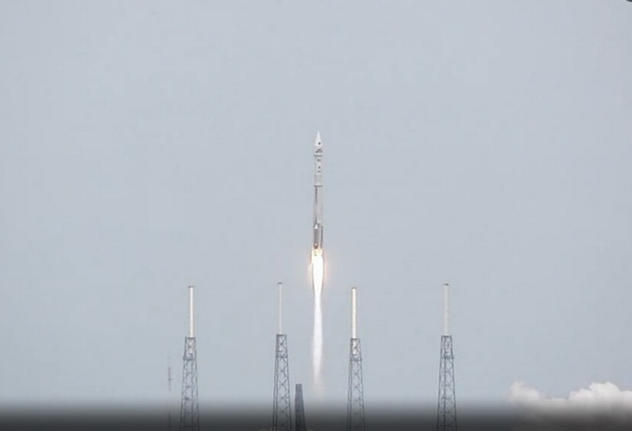
MAVEN Launches
November 18, 2013
MAVEN Launches.
Credits
NASA
ENLARGE
[51, 181]
Related
The Neutral Gas and Ion Mass Spectrometer (NGIMS) instrument, shown here at NASA's Goddard Space Flight Center in Greenbelt, Md., before its integration onto NASA’s Mars Atmosphere and Volatile Ev...
MAVEN Neutral and Ion Mass Spectrometer
This is an artist's model of an early Mars - billions of years ago - which may have had oceans and a thicker atmosphere.
Mars Evolution from Wet to Dry
Seasons change even on Mars and NASA's fleet of explorers are helping scientists learn more about the effects on the Red Planet.
Mars Report: How's the Weather on Mars?
This visualization shows MAVEN and Comet Siding Spring making their way through the solar system to a close encounter near Mars. This animation moves the camera in a bit closer and more parallel wi...
Comet Siding Spring Wide Shots
A map of MAVEN's Imaging Ultraviolet Spectrograph (IUVS) auroral detections in December 2014 overlaid on Mars’ surface.
Ultraviolet Aurora on Mars
Members of the Mars Atmosphere and Volatile Evolution (MAVEN) team celebrate at the Lockheed Martin operations center in Littleton, Colorado, Sunday night, after getting confirmation that the space...
Celebration: MAVEN Arrives at Mars
MAVEN was launched into a Hohmann Transfer Orbit with periapsis at Earth’s orbit and apoapsis at the distance of the orbit of Mars. The spacecraft will travel more than 180 degrees around the Sun i...
Hohmann Transfer Orbit
This is an artist's conception of NASA's Mars Atmosphere and Volatile Evolution MissioN (MAVEN) Mars orbiter.
Artist's Concept of MAVEN
MAVEN's Imaging UltraViolet Spectrograph obtained this image of Mars on July 13, 2016, when the planet appeared nearly full when viewed from the highest altitudes in the MAVEN orbit.
A Sharpened Ultraviolet View of Mars
These eight graphs present data from the Neutral Gas and Ion Mass Spectrometer on NASA's MAVEN orbiter identifying ions of different metals added to the Martian atmosphere shortly after comet C/201...
Ions of Eight Metals from Comet Dust Detected in Mars Atmosphere
This is an artist rendition of NASA's Mars Atmosphere and Volatile Evolution, or MAVEN spacecraft orbiting Mars.
Artist's Concept of NASA's MAVEN Spacecraft Orbiting Mars
This animation is a shorter clip from the video "Curiosity and MAVEN Explore Mars." While Curiosity will not be able to see MAVEN as it arrives at Mars, the rover welcomes the orbiter's discoveries...
Curiosity Welcomes MAVEN to Mars
A lunar eclipse, a solar eclipse and Mars has a close encounter with a comet.
What's Up for October?
NASA Science missions circle Earth, the Sun, the Moon, Mars and many other destinations within our solar system, including spacecraft that look out even further into our universe. The Science Fleet...
SMD Spacecraft Fleet
On May 16, 2013, the MAVEN spacecraft began nearly three weeks of thermal vacuum cycling, where it was exposed to the temperature swings it will experience during its mission to study the Martian u...
MAVEN in TVAC
Mars presents intriguing questions to scientists: How did the Red Planet become so desolate? Did Mars once look like Earth? How has it changed? The Mars Atmosphere and Volatile Evolution Mission (M...
MAVEN Teaser
NASA's next mission to Mars will carry a DVD containing over 1,100 entries selected as a result of the University of Colorado at Boulder's Laboratory for Atmospheric and Space Physics Going to Mars...
MAVEN Haiku Selected
These profiles show the brightness of auroras in Mars’ atmosphere at different altitudes. The solid black profile on the right is from a September 2017 solar storm. Barely visible along the vertica...
Martian Aurora 25 Times Brighter Than Prior Brightest
Download a PDF of the MAVEN Fact Sheet.
MAVEN Fact Sheet
MAVEN positioned atop Atlas V rocket.
MAVEN Positioned Atop Atlas V Rocket
Image of MAVEN spacecraft, annotated to identify instruments
MAVEN Instrument Panel
The Imaging Ultraviolet Spectrometer (IUVS) is a part of the Remote Sensing (RS) Package and measures global characteristics of the upper atmosphere and ionosphere.
Imaging Ultraviolet Spectrometer for MAVEN Spacecraft
This artist's concept depicts NASA's Mars Atmosphere and Volatile EvolutioN (MAVEN) spacecraft orbiting Mars.
MAVEN Orbiting Mars
This graphic depicts what Mars' atmosphere would have looked like to a viewer with ultraviolet-seeing eyes after a meteor shower on Oct. 19, 2014. It combines an image from the Imaging Ultraviolet ...
Emission from Ionized Magnesium in Mars' Atmosphere After Comet Flyby
This illustration shows the MAVEN spacecraft and the limb of Mars.
MAVEN Artist's Concept Orbiting Mars
You Might Also Like
The agency established the board in May 2023 to evaluate the technical, cost, and schedule plans prior to confirmation of the mission’s design.
NASA Releases Independent Review's Mars Sample Return Report
A pair of quakes in 2021 sent seismic waves deep into the Red Planet’s core, giving scientists the best data yet on its size and composition.
NASA InSight Study Provides Clearest Look Ever at Martian Core
Ten sample tubes, capturing an amazing variety of Martian geology, have been deposited on Mars’ surface so they could be studied on Earth in the future.
NASA's Perseverance Rover Completes Mars Sample Depot
Filled with rock, the sample tube will be one of 10 forming a depot of tubes that could be considered for a journey to Earth by the Mars Sample Return campaign.
NASA's Perseverance Rover Deposits First Sample on Mars Surface
The mission has concluded that the solar-powered lander has run out of energy after more than four years on the Red Planet.
NASA Retires InSight Mars Lander Mission After Years of Science
The 10 sample tubes being dropped on Mars’ surface so they can be studied on Earth in the future carry an amazing diversity of Red Planet geology.
NASA's Perseverance Rover to Begin Building Martian Sample Depot