NASA
NASA Science
Mars Exploration Program
Skip Navigation
menu
Images
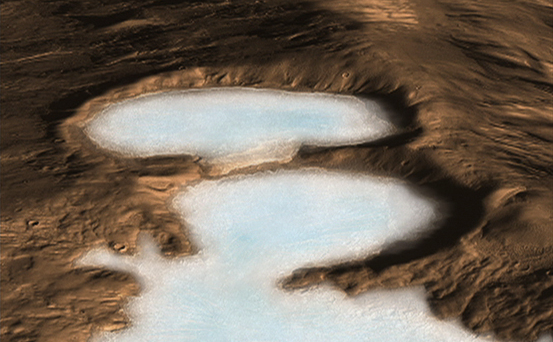
Artist concept of Glaciers on Mars
November 20, 2008
Credits
NASA/JPL-Caltech
ENLARGE
[51, 178, 188]
Related
This near-global map was captured by NASA’s Mars Reconnaissance Orbiter using its Compact Reconnaissance Imaging Spectrometer for Mars, or CRISM. The yellow square indicates the Nili Fossae region ...
One of CRISM's Final Maps of Mars
This graphic shows the ongoing contributions of NASA’s rovers and orbiters during a Martian dust storm that began on May 30, 2018.
Mars Storm Watch Observations
Two parallel tracks left by the wheels of NASA's Curiosity Mars rover cross rugged ground in this portion of a Dec. 11, 2013, observation by the High Resolution Imaging Science Experiment (HiRISE) ...
Curiosity Rover Tracks, Viewed from Orbit in December 2013
This pair of before (left) and after (right) images from the High Resolution Imaging Science Experiment (HiRISE) camera on NASA's Mars Reconnaissance Orbiter documents formation of a new channel on...
A New Gully Channel in Terra Sirenum, Mars
This artist's concept of the Mars Reconnaissance Orbiter features the spacecraft's main bus facing down, toward the red planet.
The Mars Reconnaissance Orbiter
This map shows the route driven by NASA's Curiosity Mars rover from the location where it landed in August 2012 to its location in mid-November 2015, approaching examples of dunes in the "Bagnold D...
Curiosity Rover's Traverse, First 1,163 Sols on Mars
MRO took this image of layered, sedimentary rocks on the floor of an impact crater north of Eberswalde Crater. Billions of years ago there may have been a lake in this crater.
Sedimentary Rock Layers on a Crater Floor
This scene shows dark sand dunes marching over the ridges created by an alluvial (water-deposited) fan in an impact crater.
Dunes on Ridges
This image shows a portion of the central mound in the impact crater Gale that is of interest to scientists because it is composed of light-toned layered deposits.
Layers in a Central Mound in Gale Crater (3-D)
This image shows a lava channel, which lies just to the east of the largest volcano in the solar system: Olympus Mons.
Lava Flow Near the Base of Olympus Mons
The Mars Color Imager test view looks northward and includes the large Argyre Basin in Mars' southern hemisphere.
View of Argyre Basin from Test of Mars Color Image
This map shows the footprints of images taken by the HiRISE camera on NASA's Mars Reconnaissance Orbiter as part of advance analysis of the area where NASA's InSight mission will land in 2018. The ...
Advance Inspection of NASA's Next Mars Landing Site
NASA's Curiosity rover and its parachute were spotted by NASA's Mars Reconnaissance Orbiter as Curiosity descended to the surface on Aug. 5 PDT (Aug. 6 EDT).
Curiosity Spotted on Parachute by Orbiter
Five decades of successful NASA missions to the Red Planet, 1965-2015.
50 Years of Mars Exploration
Shown in this image from NASA's Mars Reconnaissance Orbiter are fan-shaped deposits emerging from regions of steep topography called alluvial fans. Alluvial fans on Mars are thought to be ancient a...
The Case of the Martian Boulder Piles
This image, acquired on May 13, 2018 by NASA's Mars Reconnaissance Orbiter, shows sand dunes scouring what appears to be a highly-cratered, old lava flow in the Tempe Terra region, located in the N...
This is Not the Hydrothermal Deposit You're Looking For
With its cracked, blistery appearance, this mound near the center of a very large, over 5-kilometer diameter mid-latitude crater poses an interesting question: how did this form?
An Unusual Mound
Phobos in Stereo
'Marsshine' on Shadowed Part of Phobos
The Cerberus Fossae are a group of troughs in the Cerberus region of Mars that run roughly parallel to one another. They formed due to extension of the crust in the region. Some of the troughs, suc...
Vent in the Cerberus Region (3-D)
This HiRISE image shows a portion of interior layered deposits (ILD) in Juventae Chasma. Juventae Chasma is a large depression near the equatorial canyon system Valles Marineris.
Interior Layered Deposits in Juventae Chasma
As on the Earth, many processes can move material down a Martian slope. This graphic compares seven different types of features observed on Mars that appear to result from material flowing or slidi...
Martian Features Formed When Material Moves Downslope
The Electris region of Mars contains some interesting features, such as the raised-relief blocks of material visible in this image.
Remnant of Unconformable Deposit in Electris (3-D)
Two 2001 images from NASA's Mars Global Surveyor orbiter show a dramatic change in the planet's appearance during a dust storm.
The 2001 Great Dust Storms - Hellas/Syrtis Major
This image, acquired on May 15, 2018, by NASA's Mars Reconnaissance Orbiter, shows relatively bright mounds scattered throughout darker and diverse surfaces in Chryse Planitia.
Pitted Cones: Possible Methane Sources?
A regional dust storm visible in the southern hemisphere of Mars in this nearly global mosaic of observations made by the Mars Color Imager on NASA's Mars Reconnaissance Orbiter on Nov. 25, 2012.
Regional Dust Storm Weakening, Nov. 25, 2012
You Might Also Like
The agency established the board in May 2023 to evaluate the technical, cost, and schedule plans prior to confirmation of the mission’s design.
NASA Releases Independent Review's Mars Sample Return Report
A pair of quakes in 2021 sent seismic waves deep into the Red Planet’s core, giving scientists the best data yet on its size and composition.
NASA InSight Study Provides Clearest Look Ever at Martian Core
Ten sample tubes, capturing an amazing variety of Martian geology, have been deposited on Mars’ surface so they could be studied on Earth in the future.
NASA's Perseverance Rover Completes Mars Sample Depot
Filled with rock, the sample tube will be one of 10 forming a depot of tubes that could be considered for a journey to Earth by the Mars Sample Return campaign.
NASA's Perseverance Rover Deposits First Sample on Mars Surface
The mission has concluded that the solar-powered lander has run out of energy after more than four years on the Red Planet.
NASA Retires InSight Mars Lander Mission After Years of Science
The 10 sample tubes being dropped on Mars’ surface so they can be studied on Earth in the future carry an amazing diversity of Red Planet geology.
NASA's Perseverance Rover to Begin Building Martian Sample Depot