NASA
NASA Science
Mars Exploration Program
Skip Navigation
menu
Images
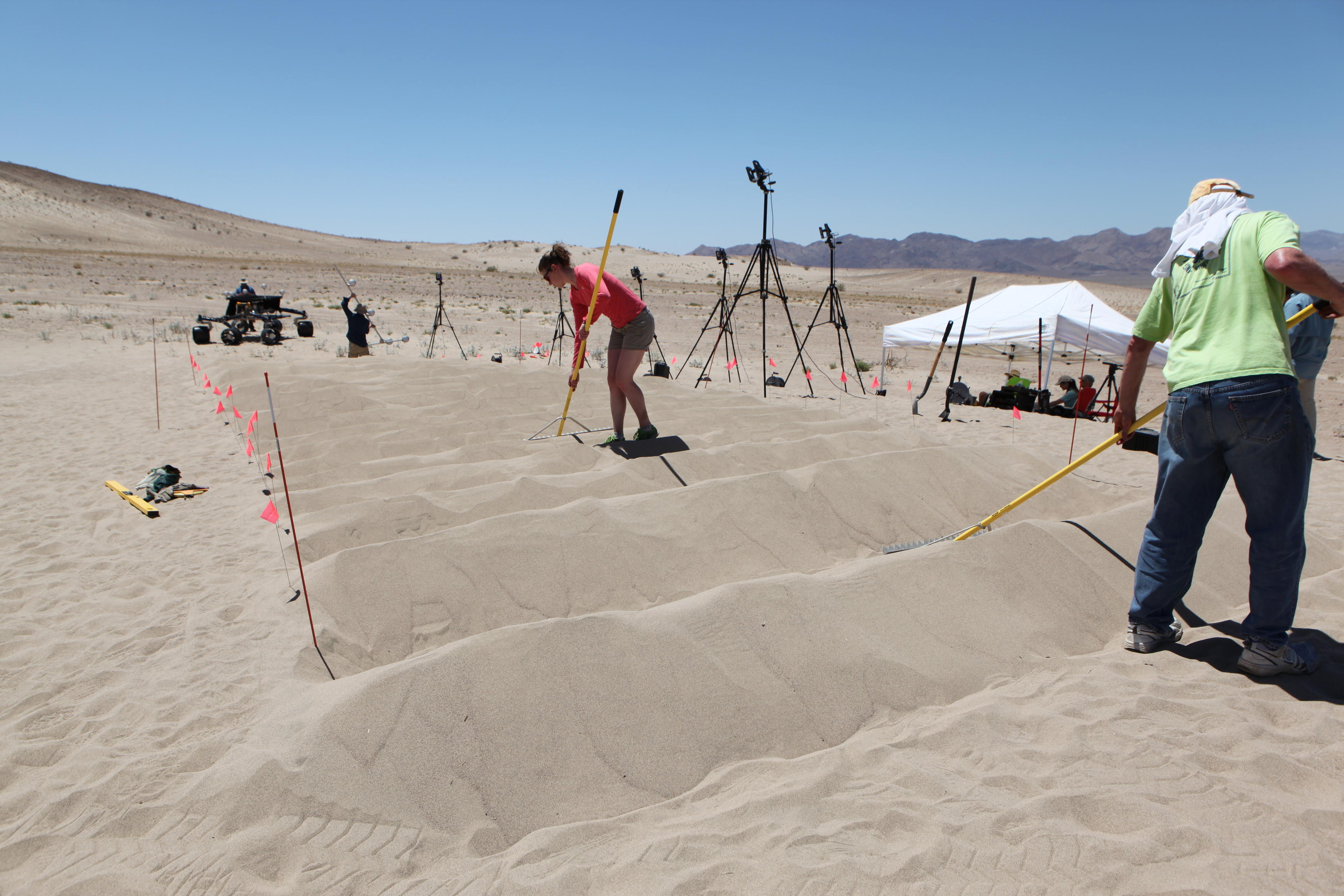
Replicating Martian Dunes
June 05, 2014
Credits
NASA/JPL-Caltech
ENLARGE
[51, 176]
Related
Scarecrow, a mobility-testing model for NASA's Mars Science Laboratory, easily traverses large rocks in the Mars Yard testing area at NASA's Jet Propulsion Laboratory.
"Scarecrow" Climbs Rocks
A swept Martian rock called "Bonanza King" can be seen in this image take by NASA's Mars Curiosity rover.
A Bonanza of Clues About Mars
Decades of work preparing a miniaturized laboratory for identifying minerals on Mars have also yielded spinoff versions with diverse applications on Earth and, possibly, the moon.
Laboratory-in-a-Box Has Uses on Mars, Earth, Elsewhere
The reclosable dust cover on Curiosity's Mars Hand Lens Imager (MAHLI) was opened for the first time during the 33rd Martian day, or sol, of the rover's mission on Mars (Sept. 8, 2012), enabling MA...
First Image From Curiosity's Arm Camera With Dust Cover Open
This image is from a test series used to characterize the 100-millimeter Mast Camera on NASA's Curiosity rover. It was taken on Aug. 23, 2012, and looks south-southwest from the rover's landing site.
Focusing the 100-millimeter Mastcam
This view of a Martian rock slab called "Old Soaker," which has a network of cracks that may have originated in drying mud, comes from the Mast Camera (Mastcam) on NASA's Curiosity Mars rover. It w...
Mars Rover's Mastcam View of Possible Mud Cracks
This image shows the Mars Science Laboratory spacecraft is suspended in a dark chamber, awaiting an environmental test.
Mars Science Laboratory Talks, Rocks, Bakes and Chills (spacecraft)
The nodule in the center of this March 10, 2016, image from the Mars Hand Lens Imager (MAHLI) on NASA's Curiosity Mars rover shows individual grains of sand and (on the right) laminations from the ...
Sandstone Nodule Beside 'Naukluft Plateau' on Mount Sharp, Mars
Where Curiosity Landed on Mars
Where Curiosity Landed on Mars
This May 25, 2015, view from the Curiosity rover's Mastcam shows a site where two different types of bedrock meet near "Marias Pass" on Mount Sharp. Pale mudstone in the foreground is like bedrock ...
Geological Contact Zone Near 'Marias Pass' on Mars
This mosaic taken by NASA's Mars Curiosity rover looks uphill at Mount Sharp, which Curiosity has been climbing.
Curiosity is Ready for Clay (Highlighted)
NASA's Mars rover Curiosity cut a wheel scuff mark into a wind-formed ripple at the "Rocknest" site to give researchers a better opportunity to examine the particle-size distribution of the materia...
Wheel Scuff Mark at 'Rocknest'
A Martian target rock called "Nova," shown here, displayed an increasing concentration of aluminum as a series of laser shots from NASA's Curiosity Mars rover penetrated through dust on the rock's ...
Curiosity's ChemCam Examines Mars Rock Target 'Nova'
These six images from NASA's Mars rover Curiosity show the two moons of Mars moments before (left three) and after (right three) the larger moon, Phobos, occulted Deimos on Aug. 1, 2013.
Before and After Occultation of Deimos by Phobos
This figure shows images acquired through each of the eight filters in the filter wheel of the 34-millimeter-focal-length Mast Camera (MastCam-34) on the Mars rover Curiosity.
Illustrating MastCam Capabilities with a Terrestrial Scene
The Martian outcrop where pale rock meets darker overlying rock near the middle of this view is an example of a geological contact.
Rover's Reward for Climbing: Exposed Geological Contact
Left and right eyes of the Navigation Camera (Navcam) in NASA's Curiosity Mars rover took the dozens of images combined into this stereo scene of the rover and its surroundings. The component image...
Mars Stereo View from "John Klein" to Mount Sharp
This image from the Navigation Camera on NASA's Curiosity Mars rover shows wheel tracks printed by the rover as it drove on the sandy floor of a lowland called "Hidden Valley" on the route toward M...
Curiosity Tracks in 'Hidden Valley' on Mars
This pairing illustrates the first time that NASA's Mars rover Curiosity collected a scoop of soil on Mars.
First Scoop by Curiosity, Sol 61 Views
Using the elements of art — shape, line, color, texture, value — learners of all ages create a beautiful piece of art while learning to recognize geologic and atmospheric features of solar system o...
Art and the Cosmic Connection
Researchers used the Mastcam on NASA's Curiosity Mars rover to gain this detailed view of layers in "Vera Rubin Ridge" from just below the ridge. The scene combines 70 images taken with the Mastcam...
Martian Ridge Looming Above Curiosity Prior to Ascent - Figure 1
NASA's Curiosity Mars rover conducted a test on Oct. 17, 2017, as part of the rover team's development of a new way to use the rover's drill. This image from Curiosity's front Hazcam shows the dril...
Mars Rover Step Toward Possible Resumption of Drilling
NASA’s Curiosity Mars rover used one of its Hazcams to catch this apparent dusty wind gust blowing overhead on March 18, 2022, the 3,418th Martian day, or sol, of the mission. Scientists believe it...
Curiosity's Hazcam Catches a Dusty Wind Gust
As the Curiosity rover hurdles toward Mars on the last leg of its journey, the Mars Science Laboratory Mission Operations Team assemble in Mission Control at the Space Flight Operations Facility at...
Team Gathers in Control Room
Teachers at the Educator Workshop listen attentively to a demonstration of Microsoft’s Kodu Mars Experience, a software program that allows students to design and create their own computer games.
The Kodu Mars Experience
You Might Also Like
The agency established the board in May 2023 to evaluate the technical, cost, and schedule plans prior to confirmation of the mission’s design.
NASA Releases Independent Review's Mars Sample Return Report
A pair of quakes in 2021 sent seismic waves deep into the Red Planet’s core, giving scientists the best data yet on its size and composition.
NASA InSight Study Provides Clearest Look Ever at Martian Core
Ten sample tubes, capturing an amazing variety of Martian geology, have been deposited on Mars’ surface so they could be studied on Earth in the future.
NASA's Perseverance Rover Completes Mars Sample Depot
Filled with rock, the sample tube will be one of 10 forming a depot of tubes that could be considered for a journey to Earth by the Mars Sample Return campaign.
NASA's Perseverance Rover Deposits First Sample on Mars Surface
The mission has concluded that the solar-powered lander has run out of energy after more than four years on the Red Planet.
NASA Retires InSight Mars Lander Mission After Years of Science
The 10 sample tubes being dropped on Mars’ surface so they can be studied on Earth in the future carry an amazing diversity of Red Planet geology.
NASA's Perseverance Rover to Begin Building Martian Sample Depot