NASA
NASA Science
Mars Exploration Program
Skip Navigation
menu
Images
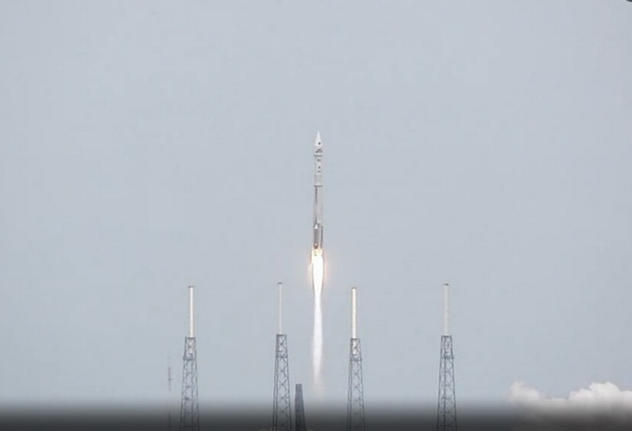
MAVEN Launches
November 18, 2013
MAVEN Launches.
Credits
NASA
ENLARGE
[51, 181]
Related
The close encounter between comet Siding Spring and Mars flooded the planet with an invisible tide of charged particles from the comet's coma. The dense inner coma reached the surface of the planet...
Close Siding Spring Encounter
NASA's Mars Atmosphere and Volatile EvolutioN, or MAVEN, spacecraft, mounted atop a United Launch Alliance Atlas V rocket, rolls out from Cape Canaveral Air Force Station's Vertical Integration Fac...
MAVEN Rolls to the Launch Pad
NASA Goddard hosted a live Google+ Hangout on Wednesday, Nov. 13 at 4 p.m. EST about MAVEN, NASA's next mission to Mars.
NASA's MAVEN Mars Mission Pre-Launch Hangout
Five decades of successful NASA missions to the Red Planet, 1965-2015.
50 Years of Mars Exploration
The Magnetometer (MAG) is a part of the Particles and Fields (P & F) Package and measures interplanetary solar wind and ionospheric magnetic fields.
MAVEN Magnetometer
This artist's concept depicts the early Martian environment (right) - believed to contain liquid water and a thicker atmosphere - versus the cold, dry environment seen at Mars today (left).
The Look of a Young Mars
Mars is experiencing large regional dust storms over its northern hemisphere during the past week.
The Martian Dust Storm of June 2018
Computer-generated visualization of the orbital paths (white dots) taken by the MAVEN spacecraft as it mapped winds (blue lines) in the Martian upper atmosphere.
MAVEN Maps Wind in the Martian Upper Atmosphere
At Cape Canaveral Air Force Station in Florida, the United Launch Alliance Atlas V first stage is lifted for stacking at Launch Pad 41 in preparation for the Mars Atmosphere and Volatile Evolution,...
MAVEN's Atlas V Lifted to Launch Pad
The Imaging Ultraviolet Spectrometer (IUVS) is a part of the Remote Sensing (RS) Package and measures global characteristics of the upper atmosphere and ionosphere.
Imaging Ultraviolet Spectrometer for MAVEN Spacecraft
To receive the same amount of starlight as Mars receives from our Sun, a planet orbiting an M-type red dwarf would have to be positioned much closer to its star than Mercury is to the Sun.
How Habitable Might an Exo-Mars Be?
This graphic depicts what Mars' atmosphere would have looked like to a viewer with ultraviolet-seeing eyes after a meteor shower on Oct. 19, 2014. It combines an image from the Imaging Ultraviolet ...
Emission from Ionized Magnesium in Mars' Atmosphere After Comet Flyby
This image shows an artist concept of NASA's Mars Atmosphere and Volatile Evolution (MAVEN) mission.
Artist Concept of NASA's Mars Atmosphere and Volatile Evolution (MAVEN)
This is an artist's conception of NASA's Mars Atmosphere and Volatile Evolution MissioN (MAVEN) Mars orbiter.
Artist's Concept of MAVEN
These eight graphs present data from the Neutral Gas and Ion Mass Spectrometer on NASA's MAVEN orbiter identifying ions of different metals added to the Martian atmosphere shortly after comet C/201...
Ions of Eight Metals from Comet Dust Detected in Mars Atmosphere
Seasons change even on Mars and NASA's fleet of explorers are helping scientists learn more about the effects on the Red Planet.
Mars Report: How's the Weather on Mars?
Following liftoff, the Mars Atmosphere and Volatile Evolution, or MAVEN, spacecraft separates from the Centaur upper stage.
MAVEN Separates from Centaur Upper Stage
The Suprathermal and Thermal Ion Composition (STATIC) instrument is part of the Particles and Fields (P & F) Package and measures thermal ions to moderate energy escaping ions.
Suprathermal And Thermal Ion Composition Instrument for MAVEN Spacecraft
Left column: From top to bottom, MAVEN data showing solar wind, solar energetic particles, proton aurora strength, diffuse aurora strength. On August 30th, a solar storm (a coronal mass ejection) i...
MAVEN Observes Martian Light Show
This is an artist rendition of NASA's Mars Atmosphere and Volatile Evolution, or MAVEN spacecraft orbiting Mars.
Artist's Concept of NASA's MAVEN Spacecraft Orbiting Mars
At Cape Canaveral Air Force Station's Space Launch Complex 41, the Mars Atmosphere and Volatile Evolution, or MAVEN, spacecraft is encapsulated atop an Atlas V rocket.
MAVEN Encapsulated Atop Atlas V
The MAVEN spacecraft is moved into the Thermal Vacuum Chamber (TVAC) at Lockheed Martin on May 16, 2013.
MAVEN moved into TVAC
This artist's concept depicts NASA's Mars Atmosphere and Volatile EvolutioN (MAVEN) spacecraft near Mars.
MAVEN at Mars, Artist's Concept
This radio hardware, the Electra UHF Transceiver on NASA's MAVEN mission to Mars, is designed to provide communication relay support for robots on the surface of Mars.
Electra Relay Radio on MAVEN Mission to Mars
The orbit of MAVEN sometimes crosses the orbit of Phobos. This image shows the configuration of the two orbits in early December 2015, when MAVEN's Phobos observations were made.
Orbit of MAVEN and Phobos
You Might Also Like
The agency established the board in May 2023 to evaluate the technical, cost, and schedule plans prior to confirmation of the mission’s design.
NASA Releases Independent Review's Mars Sample Return Report
A pair of quakes in 2021 sent seismic waves deep into the Red Planet’s core, giving scientists the best data yet on its size and composition.
NASA InSight Study Provides Clearest Look Ever at Martian Core
Ten sample tubes, capturing an amazing variety of Martian geology, have been deposited on Mars’ surface so they could be studied on Earth in the future.
NASA's Perseverance Rover Completes Mars Sample Depot
Filled with rock, the sample tube will be one of 10 forming a depot of tubes that could be considered for a journey to Earth by the Mars Sample Return campaign.
NASA's Perseverance Rover Deposits First Sample on Mars Surface
The mission has concluded that the solar-powered lander has run out of energy after more than four years on the Red Planet.
NASA Retires InSight Mars Lander Mission After Years of Science
The 10 sample tubes being dropped on Mars’ surface so they can be studied on Earth in the future carry an amazing diversity of Red Planet geology.
NASA's Perseverance Rover to Begin Building Martian Sample Depot