NASA
NASA Science
Mars Exploration Program
Skip Navigation
menu
Images
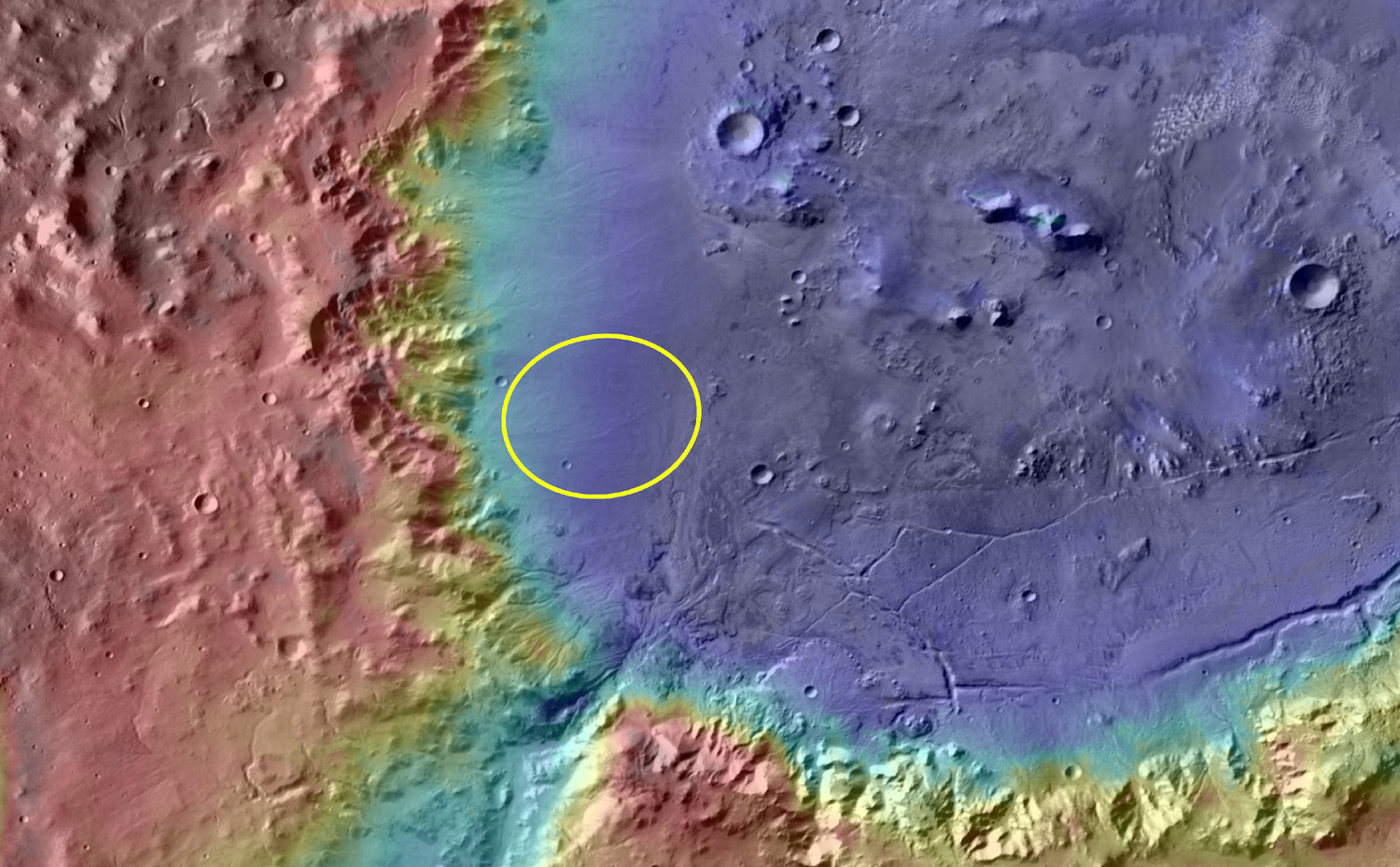
Holden Crater
February 15, 2009
Holden Crater
Credits
NASA/JPL-Caltech
ENLARGE
[51, 176]
Related
Curiosity is the biggest robot explorer ever to rove Mars. How do you power something like that?
Mars Rover Power
The right Mast Camera (Mastcam) of NASA's Curiosity Mars rover provided this contextual view of the vicinity of the location called "John Klein," selected as Curiosity's first drilling site.
Diversity in Vicinity of Curiosity's First Drilling Target (Unannotated)
This video of thumbnail images from the Mars Descent Imager (MARDI) on NASA's Curiosity rover shows the heat shield dropping away from the rover on Aug. 5 PDT (Aug. 6 EDT). It covers the first 25 s...
Curiosity Bids Goodbye to Heat Shield
A wheel track cuts through a windblown ripple of dusty sand in this Nov. 7, 2014, image from the Mastcam on NASA's Curiosity rover. The view spans about four feet across. This experiment was planne...
Ripple's Interior Exposed by Rover Wheel Track (Labeled)
The Sample Analysis at Mars instrument suite will weigh about 83 pounds (38 kilograms) and make up about half the science payload of the Mars Science Laboratory mission. It is a suite of three inst...
Sample Analysis at Mars
Access Mars allows any member of the public to explore the discoveries of NASA's Curiosity rover.
Access Mars
Twenty-one times during the first 12 weeks that NASA's Mars rover Curiosity worked on Mars, the rover's Rover Environmental Monitoring Station (REMS) detected brief dips in air pressure that could ...
Signs of a Whirlwind in Gale Crater
"Vera Rubin Ridge," a favored destination for NASA's Curiosity Mars rover even before the rover landed in 2012, rises near the rover nearly five years later in this panorama from Curiosity's Mast C...
Curiosity View of 'Vera Rubin Ridge' From Below, Sol 1734 - Figure 1
This stereo view from NASA's Mars rover Curiosity shows a rock called "Link," which bears rounded pebbles that provide evidence about vigorous flow of water in a stream on ancient Mars.
Evidence About a Martian Streambed (Stereo - Raw Color)
The Mars Science Laboratory (MSL) team in the MSL Mission Support Area react after learning the Curiosity rover has landed safely on Mars and images start coming in at the Jet Propulsion Laboratory...
The Mars Science Laboratory Team
In the Payload Hazardous Servicing Facility at NASA's Kennedy Space Center in Florida, technicians process the backshell for NASA's Mars Science Laboratory (MSL).
Preparing the Backshell
By monitoring weather through two Martian years since landing in Gale Crater, NASA's Curiosity Mars rover has documented seasonal patterns in variables such as temperature, water-vapor content and ...
Seasonal Cycles in Curiosity's First Two Martian Years
This image from NASA's Curiosity rover shows the great diversity of grains found on the surface of a Martian rock.
Texture of 'Gillespie Lake' Rock
This graphic from NASA's Curiosity mission shows an analysis of the composition of two rocks called "Crest" and "Rapitan" in the "Yellowknife Bay" area of Mars.
Signs of Hydrated Calcium Sulfates in Martian Rocks
This photograph of the NASA Mars Science Laboratory rover, Curiosity, was taken during mobility testing on June 3, 2011. The location is inside the Spacecraft Assembly Facility at NASA's Jet Propul...
Mars Rover Curiosity with Wheel on Ramp
Curiosity shakes up a scoopful of dirt, dusts off the sampling system and investigates a shiny object on the surface of Mars.
Here's the Scoop!
Cross-bedding seen in the layers of this Martian rock is evidence of movement of water recorded by waves or ripples of loose sediment the water passed over.
Martian Rock's Evidence of Lake Currents
This is the first image taken by the Navigation cameras on NASA's Curiosity rover. It shows the shadow of the rover's now-upright mast in the center, and the arm's shadow at left. The arm itself ca...
Curiosity Looks Away from the Sun
U.S. Vice President Mike Pence, right, is presented a plaque by JPL Director Michael Watkins during a tour of NASA's Jet Propulsion Laboratory, Saturday, April 28, 2018 in Pasadena, California. The...
Vice President Pence Tours Jet Propulsion Laboratory
This diagram and the one at PIA16916 illustrate how the Dynamic Albedo of Neutrons (DAN) instrument on NASA's Curiosity Mars rover detects hydrogen in the ground beneath the rover.
Physics of How DAN on Curiosity Checks for Water, Part 2
This view of terrestrial rocks was taken by a testing twin -- the "life test unit" -- of the Mars Hand Lens Imager (MAHLI) camera on NASA's Mars Science Laboratory.
Test Image of Earth Rocks by Mars Camera
How samples are delivered and then tested in the Sample Analysis at Mars (SAM) suite on the Mars Curiosity rover. (No audio)
Sample Analysis at Mars (SAM) suite on Mars Curiosity
This rectangular version of a self-portrait of NASA's Mars rover Curiosity combines dozens of exposures taken by the rover's Mars Hand Lens Imager (MAHLI) during the 177th Martian day, or sol, of ...
Curiosity Rover's Self Portrait at 'John Klein' Drilling Site, Cropped
This graphic offers comparisons between the amount of an organic chemical named chlorobenzene detected in the "Cumberland" rock sample and amounts of the same compound in samples from three other M...
Comparing 'Cumberland' With Other Samples Analyzed by Curiosity
This stereo view from NASA's Curiosity Mars Rover shows the downwind side of a dune about 13 feet high within the Bagnold Dunes on Mars. The image appears three-dimensional when viewed through red-...
Downwind Side of 'Namib' Sand Dune on Mars, Stereo
You Might Also Like
The agency established the board in May 2023 to evaluate the technical, cost, and schedule plans prior to confirmation of the mission’s design.
NASA Releases Independent Review's Mars Sample Return Report
A pair of quakes in 2021 sent seismic waves deep into the Red Planet’s core, giving scientists the best data yet on its size and composition.
NASA InSight Study Provides Clearest Look Ever at Martian Core
Ten sample tubes, capturing an amazing variety of Martian geology, have been deposited on Mars’ surface so they could be studied on Earth in the future.
NASA's Perseverance Rover Completes Mars Sample Depot
Filled with rock, the sample tube will be one of 10 forming a depot of tubes that could be considered for a journey to Earth by the Mars Sample Return campaign.
NASA's Perseverance Rover Deposits First Sample on Mars Surface
The mission has concluded that the solar-powered lander has run out of energy after more than four years on the Red Planet.
NASA Retires InSight Mars Lander Mission After Years of Science
The 10 sample tubes being dropped on Mars’ surface so they can be studied on Earth in the future carry an amazing diversity of Red Planet geology.
NASA's Perseverance Rover to Begin Building Martian Sample Depot