NASA
NASA Science
Mars Exploration Program
Skip Navigation
menu
Images
Landing Site Region
January 11, 2007
Credits
NASA/JPL/Univ. of Arizona
ENLARGE
[51, 178]
Related
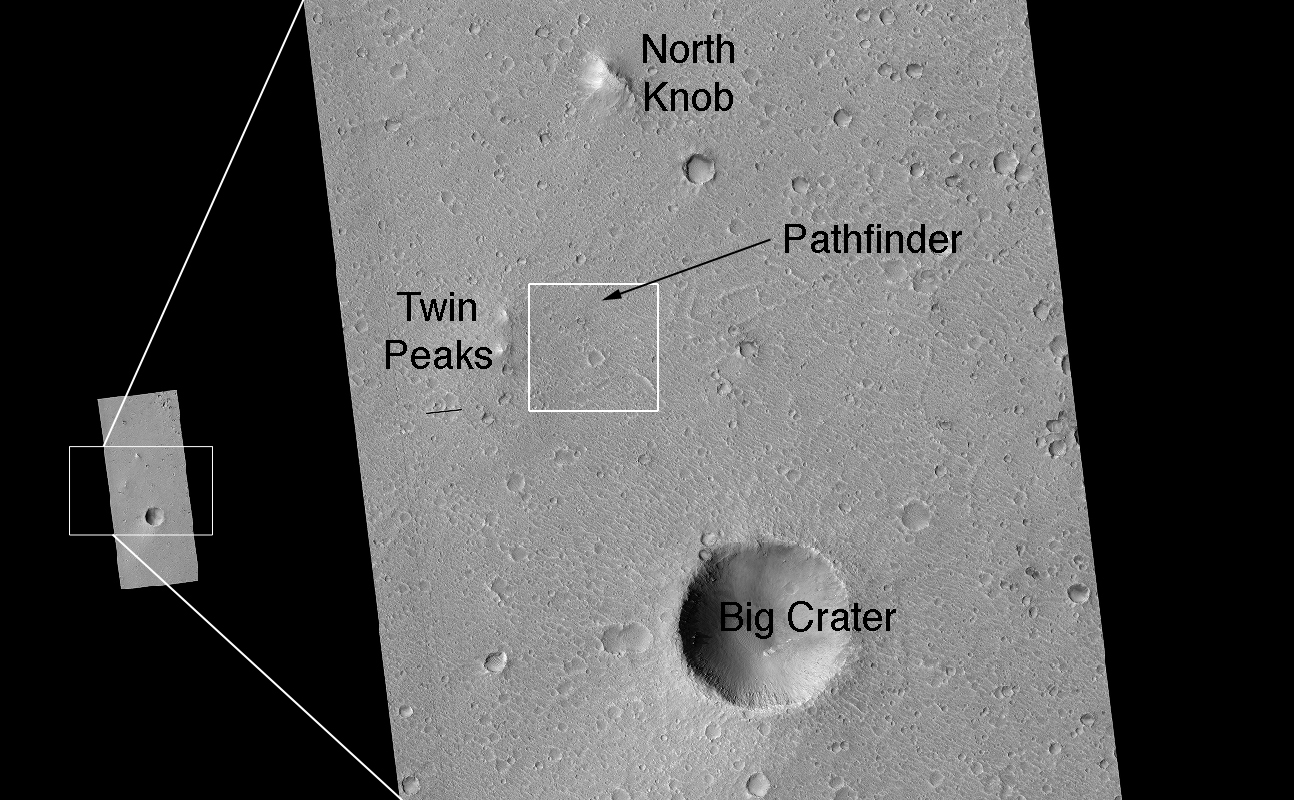
Near the lower left corner of this view is the three-petal lander platform that NASA's Mars Exploration Rover Spirit drove off in January 2004.
Spirit Lander and Bonneville Crater in Color
This series of images from NASA's Mars Reconnaissance Orbiter successively zooms into "spider" features -- or channels carved in the surface in radial patterns -- in the south polar region of Mars.
Volunteers Help Decide Where to Point Mars Camera
This view of Martian surface features shaped by effects of winds was captured by the HiRISE camera on NASA's Mars Reconnaissance Orbiter on Jan. 4, 2015. The spacecraft has been orbiting Mars sinc...
Yardangs in Arsinoes Chaos, Mars
This map shows the route driven by NASA's Curiosity Mars in its approach to and April 1, 2014, arrival at a waypoint called "the Kimberley," which rover team scientists chose in 2013 as the locatio...
Map of Curiosity Mars Rover's Drives to 'the Kimberley' Waypoint
This HiRISE image shows erosional features formed by seasonal frost near the south pole of Mars.
Erosion Features near the South Pole of Mars
This graphic shows the route that NASA's Mars Exploration Rover Opportunity drove in its final approach to "Perseverance Valley" on the western rim of Endeavour Crater during spring 2017.
From 'Tribulation' to 'Perseverance' on Mars
The upper portion of this map is from an observation by the Context Camera on NASA's Mars Reconnaissance Orbiter of a field of dark sand dunes in the Nili Patera region of Mars.
Location Map for Images of Changing Martian Dunes
Animation of a skinny "dust devil" on the dust-covered Amazonis Planitia region of northern Mars. (No audio)
Mars' Whirling Dust Devil
This mosaic, taken with the High Resolution Imaging Science Experiment (HiRISE) camera on NASA's Mars Reconnaissance Orbiter, shows the planned route (in yellow) of NASA's Curiosity rover from "Pah...
Curiosity Rover Planned Route
This picture of a heart-shaped pit was taken on 26 February 2008 by the CTX camera aboard MRO. It is approximately 2 km long. The pit is one of many adjacent to Hydaspis Chaos, a jumbled topographi...
From the Pit of My Heart
This image acquired on December 9, 2018 by NASAs Mars Reconnaissance Orbiter, shows Athabasca Valles with lava flows originating from Elysium Mons to the northwest.
Almost Like Water
Researchers estimating the amount of carbon held in the ground at the largest known carbonate-containing deposit on Mars utilized data from three different NASA Mars orbiters.
Multiple Instruments Used for Mars Carbon Estimate
Eridania Basin Light-Toned Outcrops
Eridania Basin Light-Toned Outcrops
This image taken by NASA’s Mars Reconnaissance Orbiter shows ice sheets at Mars’ south pole. The spacecraft detected clays nearby this ice; scientists have proposed such clays are the source of rad...
MRO Spots Clays and Ice
This HiRISE image shows a valley filled with an assortment of linear ridges. These ridges are often referred to as transverse aeolian ridges, or TAR, and they take a variety of forms.
Feathery Ridges
Well-Preserved Crater with Central Peak in Chryse Planitia
Well-Preserved Crater with Central Peak in Chryse Planitia
These images from orbit show an area near Mars' south pole where coalescing or elongated pits are interpreted as signs that an underlying deposit of frozen carbon dioxide, or "dry ice," has been sh...
Pitting from Sublimation of Underlying Dry-Ice Layer
NASA's Mars Reconnaissance Orbiter observes many slopes in the middle latitudes of Mars showing icy flows or glaciers. The region shown here, in the south-facing slope of a crater, is unusual becau...
Go with the (Bright) Flow
Layers in the lower portion of two neighboring buttes within the Noctis Labyrinthus formation on Mars are visible in this image from the High Resolution Imaging Science Experiment (HiRISE) camera o...
Light-Toned Deposits in Noctis Labyrinthus
Wind is one of the most active forces shaping Mars’ surface in today’s climate. Wind-carved features such as these, called “yardangs,” are common on the Red Planet.
Wind at Work
Sand dunes are among the most widespread wind-formed (aeolian) features present on Mars.
Dune Composition (3-D)
This crater has gullies on its southwest-facing walls and rim, as well as and what appears to be two separate instances of lobate (ear-shaped) material associated to its interior gullies.
Gullies and Lobate Material in a Crater in Nereidum Montes (3-D)
This is the first image of Mars taken by the Context Camera on NASA's Mars Reconnaissance Orbiter.
First Context Camera Image of Mars
This inner slope of a Martian crater has several of the seasonal dark streaks called "recurrent slope lineae," or RSL, that a November 2017 report interprets as granular flows, rather than darkenin...
Seasonal Dark Streaks in Tivat Crater, Mars
This image shows part of Ladon Vallis that is located within Ladon basin.
Light-Toned Layered Rock Outcrop in Ladon Valles (3-D)
You Might Also Like
The agency established the board in May 2023 to evaluate the technical, cost, and schedule plans prior to confirmation of the mission’s design.
NASA Releases Independent Review's Mars Sample Return Report
A pair of quakes in 2021 sent seismic waves deep into the Red Planet’s core, giving scientists the best data yet on its size and composition.
NASA InSight Study Provides Clearest Look Ever at Martian Core
Ten sample tubes, capturing an amazing variety of Martian geology, have been deposited on Mars’ surface so they could be studied on Earth in the future.
NASA's Perseverance Rover Completes Mars Sample Depot
Filled with rock, the sample tube will be one of 10 forming a depot of tubes that could be considered for a journey to Earth by the Mars Sample Return campaign.
NASA's Perseverance Rover Deposits First Sample on Mars Surface
The mission has concluded that the solar-powered lander has run out of energy after more than four years on the Red Planet.
NASA Retires InSight Mars Lander Mission After Years of Science
The 10 sample tubes being dropped on Mars’ surface so they can be studied on Earth in the future carry an amazing diversity of Red Planet geology.
NASA's Perseverance Rover to Begin Building Martian Sample Depot