NASA
NASA Science
Mars Exploration Program
Skip Navigation
menu
Images
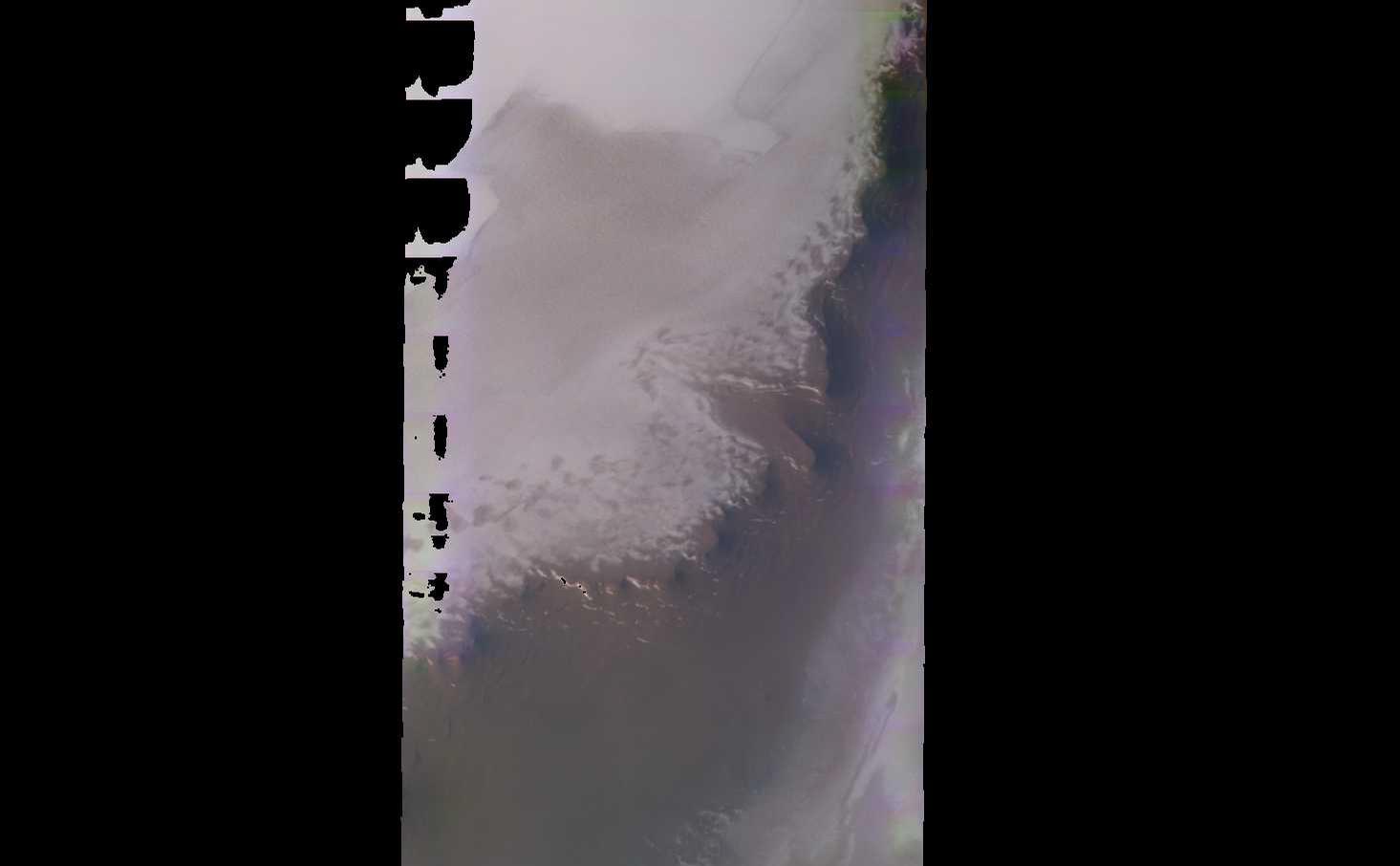
Planum Boreum crater
March 03, 2003
Planum Boreum crater
Credits
NASA/JPL-Caltech/ASU
ENLARGE
[51, 179]
Related
NASA's 2001 Mars Odyssey orbiter arrived at Mars on Oct. 24, 2001.
Mars Odyssey Orbiter By the Numbers
Sixteen seventh-graders at Evergreen Middle School in Cottonwood, Calif., found the Martian pit feature at the center of the superimposed red square in this image while participating in a program t...
Martian Pit Feature Found by Seventh Graders
This image from NASA's 2001 Mars Odyssey spacecraft shows part of the margin of the north polar cap and the surrounding plains. The layering of the ice is easily visible due to the dust that is dep...
Polar Layers
Six views of the Martian moon Phobos captured by NASA's Odyssey orbiter as of March 2020. The orbiter's THEMIS camera is used to measure temperature variations that suggest what kind of material th...
Odyssey's Six Views of Phobos
Color coding in this map of a far-northern site on Mars indicates the change in nighttime ground-surface temperature between summer and fall. This site, like most of high-latitude Mars, has water i...
Depth-to-Ice Map of an Arctic Site on Mars
Mars is experiencing large regional dust storms over its northern hemisphere during the past week.
The Martian Dust Storm of June 2018
Download a PDF of the 2001 Mars Odyssey Launch Press Kit.
2001 Mars Odyssey Launch Press Kit
Buzz Aldrin, an Apollo 11 astronaut who walked on the moon, makes a holographic appearance in 'Destination: Mars,' a mixed-reality tour of a part of Mars that NASA's Curiosity rover has explored.
Buzz Aldrin
Researchers estimating the amount of carbon held in the ground at the largest known carbonate-containing deposit on Mars utilized data from three different NASA Mars orbiters.
Multiple Instruments Used for Mars Carbon Estimate
These three views of the Martian moon Phobos were taken by NASA's 2001 Mars Odyssey orbiter using its infrared camera, THEMIS. Each color represents a different temperature range.
Odyssey's Three Views of Phobos
Snow falls and ice and frost form on Mars, too. NASA's spacecraft on and orbiting the Red Planet reveal the similarities to and differences from how we experience winter on Earth.
Mars Report: Winter Wonderland on Mars
Wind shadow and real shadow combine to give a striking image of a comet.
THEMIS Images as Art
How do you converse with a robot nearly one hundred million miles away? In this video, Odyssey team members describe communications with the 2001 Mars Odyssey spacecraft using the antennas of the D...
Challenges of Getting to Mars: Telecommunications
A small impact crater on Mars named Gratteri, 4.3 miles (6.9 km) wide, lies at the center of large dark streaks.
Mars Impact Crater Gratteri
This image shows the context for orbital observations of exposed rocks that had been buried an estimated 5 kilometers (3 miles) deep on Mars.
Nature's Drilling Exposes Deeply Buried Minerals
Download a PDF of the Explore Mars Sticker.
Explore Mars Sticker
This pair of maps indicates locations of confirmed sites of recurrent slope linea on Mars, with respect to elevation (upper map) and surface brightness, or albedo (lower map).
Maps of Recurrent Slope Linea Markings on Mars
This image from NASA's Mars Odyssey shows ice-rich clouds over the summit of Arsia Mons.
Ice-Rich Clouds - False Color
This map shows unprecedented detail of local variations in Mars' gravitational pull on orbiters. The gravitational mapping has been applied to map variations in the thickness of the planet's crust ...
Local Variations in the Gravitational Pull of Mars
The dunes and dust devil tracks in this VIS image are located on the plains of Planum Chronium.
Dunes and dust devil tracks in Planum Chronium
This image combines two products from the first pointing at the Martian moon Phobos by the THEMIS camera on NASA's Mars Odyssey orbiter, on Sept. 29, 2017. Surface-temperature information from obse...
Temperature Gradient on Martian Moon Phobos
Dr. Phil Varghese, Odyssey Project Manager.
Dr. Phil Varghese
NASA's Mars Odyssey spacecraft passes above Mars' south pole in this artist's concept illustration. The spacecraft has been orbiting Mars since October 24, 2001.
Odyssey over Mars' South Pole
This image of a crater in Acidalia Planitia was acquired March 8, 2003, during northern summer.
Acidalia Planitia Crater
Bacolor Crater is a magnificent impact feature about 20 kilometers (12 miles) wide.
Mars Odyssey All Stars: Bacolor Crater
You Might Also Like
The agency established the board in May 2023 to evaluate the technical, cost, and schedule plans prior to confirmation of the mission’s design.
NASA Releases Independent Review's Mars Sample Return Report
A pair of quakes in 2021 sent seismic waves deep into the Red Planet’s core, giving scientists the best data yet on its size and composition.
NASA InSight Study Provides Clearest Look Ever at Martian Core
Ten sample tubes, capturing an amazing variety of Martian geology, have been deposited on Mars’ surface so they could be studied on Earth in the future.
NASA's Perseverance Rover Completes Mars Sample Depot
Filled with rock, the sample tube will be one of 10 forming a depot of tubes that could be considered for a journey to Earth by the Mars Sample Return campaign.
NASA's Perseverance Rover Deposits First Sample on Mars Surface
The mission has concluded that the solar-powered lander has run out of energy after more than four years on the Red Planet.
NASA Retires InSight Mars Lander Mission After Years of Science
The 10 sample tubes being dropped on Mars’ surface so they can be studied on Earth in the future carry an amazing diversity of Red Planet geology.
NASA's Perseverance Rover to Begin Building Martian Sample Depot