NASA
NASA Science
Mars Exploration Program
Skip Navigation
menu
Images
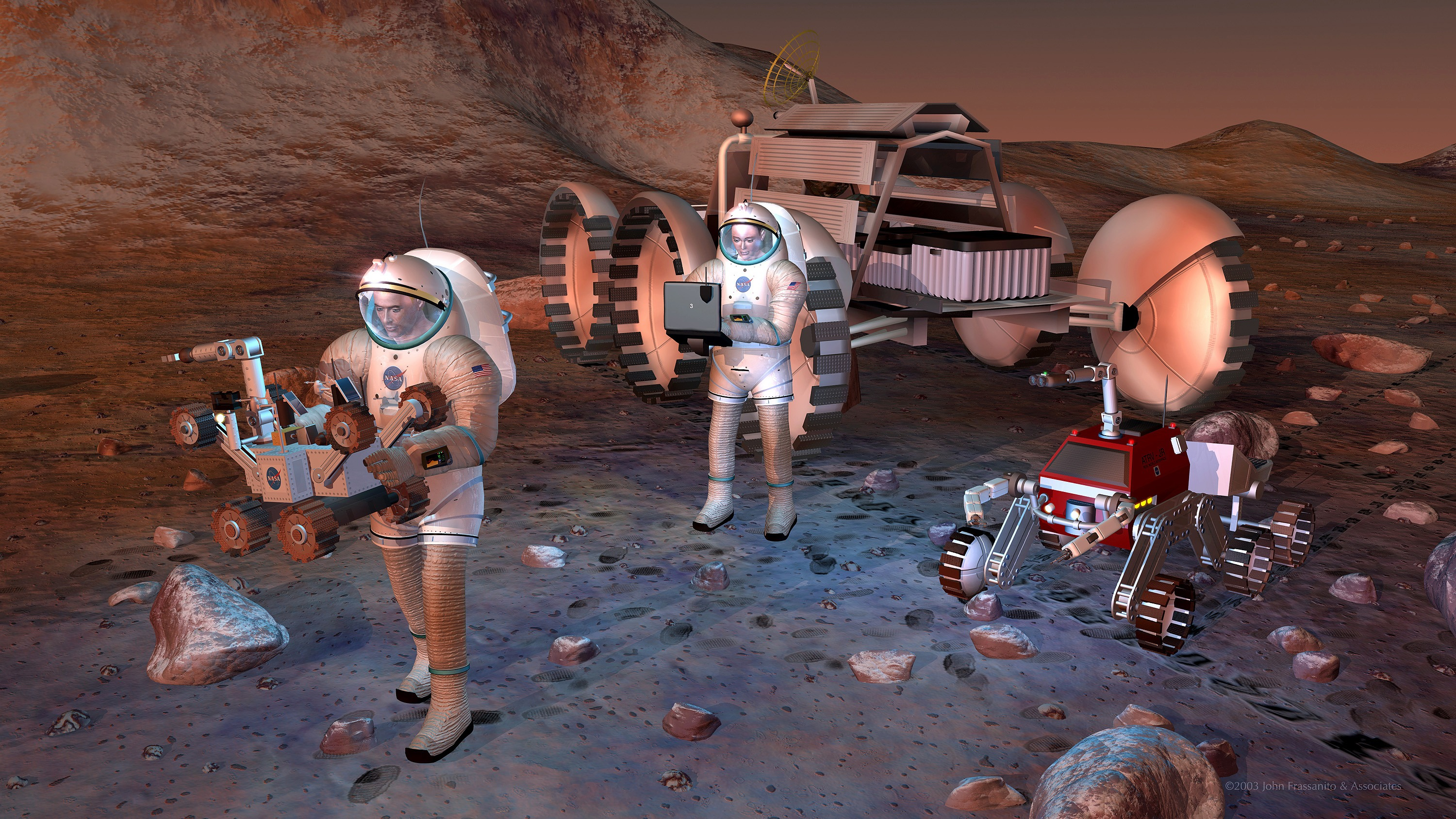
Artist's concept of future humans on Mars.
August 24, 2004
Credits
NASA/JPL-Caltech
ENLARGE
[51, 179]
Related
This computer-generated view based on multiple orbital observations shows Mars' Gale crater as if seen from an aircraft north of the crater.
Oblique view of Gale Crater from the North
Women working in science, technology, engineering and mathematics at NASA's Jet Propulsion Laboratory pose for a photo in mission control in honor of Women in Science Day.
Women in Science
A large mound of sand and dune forms are located on the floor of an unnamed crater south of Rabe Crater in Noachis Terra.
Rabe Crater in Noachis Terra
Sand-laden jets shoot into the polar sky in this view by noted space artist Ron Miller.
Sand-Laden Jets
This unnamed channel drains part of Margaritifer Terra.
Channel in Margaritifer Terra.
Phobos and Deimos, the moons of Mars, are seen in this image from NASA's 2001 Mars Odyssey orbiter. The distance to Deimos from Odyssey during the observation was about 12,222 miles (19,670 kilomet...
Mars Odyssey Observes Martian Moons
NASA's 2001 Mars Odyssey orbiter arrived at Mars on Oct. 24, 2001.
Mars Odyssey Orbiter By the Numbers
The Thermal Emission Imaging System (THEMIS) camera on NASA's Mars Odyssey spacecraft has completed an unprecedented full decade of observing Mars from orbit.
Tenth Anniversary Image from Camera on NASA Mars Orbiter
This image is near the southern edge of a low, broad volcanic feature called Syrtis Major.
Syrtis Major
The dunes and dust devil tracks in this VIS image are located on the plains of Planum Chronium.
Dunes and dust devil tracks in Planum Chronium
This image shows a 90-mile-wide portion of the giant Valles Marineris canyon system. Landslide debris and gullies in the canyon walls on Mars can be seen at 100 meters (330 feet) per pixel.
Close View of Valles Marineris
Around 200 kilometers long, Ravi Vallis was born in a flood of water from Aromatum Chaos.
Ravi Vallis
Artist’s concept of Comet Siding Spring approaching Mars, shown with NASA’s orbiters preparing to make science observations of this unique encounter.
NASA's Mars Orbiters Maneuvers as Comet Siding Spring Approaching Mars
This region of Terra Sabaea contains areas with high densities of small craters.
Lot of Craters in Terra Sabaea
Valles Marineris, the "Grand Canyon of Mars," sprawls wide enough to reach from Los Angeles to nearly New York City, if it were located on Earth. The red outline box shows the location of a second,...
Valles Marineris, the "Grand Canyon of Mars"
This image captured by NASA's 2001 Mars Odyssey spacecraft shows a section of Nanedi Valles, located in Xanthe Terra.
Nanedi Valles
Researchers estimating the amount of carbon held in the ground at the largest known carbonate-containing deposit on Mars utilized data from three different NASA Mars orbiters.
Multiple Instruments Used for Mars Carbon Estimate
This unnamed channel is located in Xanthe Terra.
Channel in Xanthe Terra
Newly detailed mapping of local variations in Mars' gravitational pull on orbiters (center), combined with topographical mapping of the planet's mountains and valleys (left), yields the best-yet ma...
Using Gravity and Topography to Map Mars' Crustal Thickness
Mars program Chief Engineer Robert Shotwell describes Mars Odyssey's unprecedented view of comet Siding Spring as the comet sweeps by the Red Planet on Oct. 19 and how it will maneuver to take images.
NASA's Mars Odyssey Maneuvers to Image Comet Siding Spring
Ius Chasma is unique from the other chasmata of Valles Marineris in possessing mega gullies on both sides of the chasma. This image was captured by NASA's 2001 Mars Odyssey spacecraft.
Investigating Mars: Ius Chasma
This movie shows the Martian moon Phobos as viewed in visible light by NASA's 2001 Mars Odyssey orbiter on April 24, 2019. The apparent motion is due to movement by Odyssey's infrared camera, Therm...
Odyssey Views Phobos in Visible Light: April 24, 2019
At the time this video was released, the Odyssey team had successfully completed the third trajectory correction maneuver to adjust the spacecraft's flightpath toward its final aimpoint for entry i...
Challenges of Getting to Mars: Interplanetary Cruise
Chasma Boreale is a long, flat-floored valley that cuts deep into Mars' north polar icecap
Mars Odyssey All Stars: Chasma Boreale
This animation shows how NASA's Curiosity rover communicates with Earth via two of NASA's Mars orbiters, Mars Reconnaissance Orbiter (MRO) and Odyssey, and the European Space Agency's Mars Express....
Curiosity Communicates with Help From Its 'Friends'
You Might Also Like
The agency established the board in May 2023 to evaluate the technical, cost, and schedule plans prior to confirmation of the mission’s design.
NASA Releases Independent Review's Mars Sample Return Report
A pair of quakes in 2021 sent seismic waves deep into the Red Planet’s core, giving scientists the best data yet on its size and composition.
NASA InSight Study Provides Clearest Look Ever at Martian Core
Ten sample tubes, capturing an amazing variety of Martian geology, have been deposited on Mars’ surface so they could be studied on Earth in the future.
NASA's Perseverance Rover Completes Mars Sample Depot
Filled with rock, the sample tube will be one of 10 forming a depot of tubes that could be considered for a journey to Earth by the Mars Sample Return campaign.
NASA's Perseverance Rover Deposits First Sample on Mars Surface
The mission has concluded that the solar-powered lander has run out of energy after more than four years on the Red Planet.
NASA Retires InSight Mars Lander Mission After Years of Science
The 10 sample tubes being dropped on Mars’ surface so they can be studied on Earth in the future carry an amazing diversity of Red Planet geology.
NASA's Perseverance Rover to Begin Building Martian Sample Depot