NASA
NASA Science
Mars Exploration Program
Skip Navigation
menu
CURIOSITY IMAGES
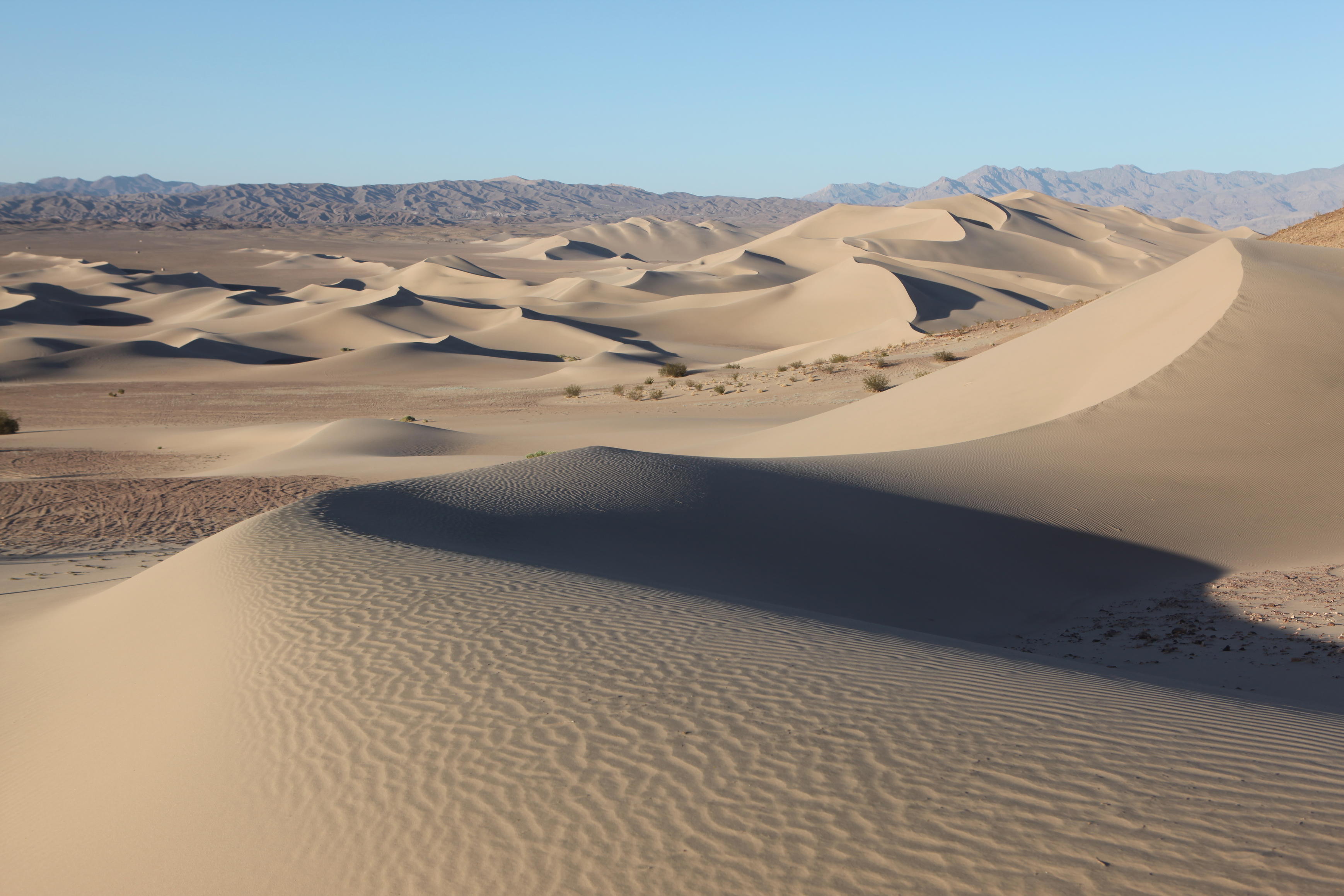
Sandy Dunes
June 05, 2014
Credits
NASA/JPL-Caltech
ENLARGE
[51, 176]
Related
A close-up view of a microchip with 1.2 million names that will be placed aboard NASA's Mars Curiosity Rover. Engineers etched the names onto a silicon wafer or microchip. They used an electron be...
Microchip with 1.2 Million Names
The left-front wheel of NASA's Curiosity Mars rover shows dents and holes in this image taken during the 469th Martian day, or sol, of the rover's work on Mars (Nov. 30, 2013).
Left-Front Wheel of Curiosity Rover, Approaching Three Miles
This closeup view from NASA's Curiosity rover shows finely layered rocks, deposited by wind long ago as migrating sand dunes.
Farewell to Murray Buttes (Image 3)
The Mars Hand Lens Imager (MAHLI) camera at the end of the robotic arm of NASA's Curiosity rover will use a calibration target attached to a shoulder joint of the arm.
Calibration Target on Curiosity for Camera on Rover's Arm
This full-resolution color image from NASA's Curiosity Rover shows the gravel-covered surface of Mars. It was taken by the Mars Descent Imager (MARDI) several minutes after Curiosity touched down o...
Gravel-Covered Martian Surface
This image shows the calibration target for the Chemistry and Camera instrument on NASA's Curiosity rover before it was installed on the rover and readied for launch.
Pre-Launch Calibration Target for ChemCam
NASA's Mars rover Curiosity drove 6.2 feet (1.9 meters) during the 100th Martian day, or sol, of the mission (Nov. 16, 2012).
Curiosity's Eastward View After Sol 100 Drive, Stereo
This color panorama shows a 360-degree view of the landing site of NASA's Curiosity rover, including the highest part of Mount Sharp visible to the rover. That part of Mount Sharp is approximately ...
Landing Site Panorama, with the Heights of Mount Sharp
A web of shadows stretches across the 197-foot-tall United Launch Alliance Atlas V rocket as the early morning sun shines through a metal lightning mast (left) at Space Launch Complex 41 on Cape Ca...
Sunshine Drapes Atlas V Rocket
Teachers gather at NASA’s Jet Propulsion Laboratory (JPL) in Pasadena, Calif., for the Curiosity Landing Educator Workshop.
Curiosity Landing Educator Workshop
This view from NASA's Curiosity Mars Rover shows the downwind side of a dune about 13 feet high within the Bagnold Dunes field on Mars. The rover's Navigation Camera took the component images on De...
Slip face on Downwind Side of 'Namib' Sand Dune on Mars
This image show the MSL BUD team
"Hanging Six" on Mars
NASA's Mars Science Laboratory lifts off from Cape Canaveral Air Force Station, Fla.
Mars Mission Blasts Off
This image shows a closeup view of the two pairs of camera lenses on a shelf. The left-hand pair are larger than the right-hand pair, go to the hazard avoidance camera, and have a larger, fish-eye ...
Martian Eyes Are Watching
A close-up image of a 2-inch-deep hole produced using a new drilling technique for NASA's Curiosity rover. The hole is about 0.6 inches across (1.6 centimeters). This image was taken by Curiosity's...
Curiosity Successfully Drills "Duluth"
This self-portrait shows the deck of NASA's Curiosity rover from the rover's Navigation camera.
Bird's Eye View of Curiosity
This stereo view from the Curiosity Mars rover's Navcam shows a 360-degree panorama around the site where the rover spent its 1,000th Martian day, or sol, on Mars. The image appears three-dimension...
Panorama from Curiosity's Sol 1000 Location (Stereo)
This May 12, 2014, view from the Mars Hand Lens Imager (MAHLI) in NASA's Curiosity Mars Rover shows the rock target "Windjana" and its immediate surroundings after inspection of the site by the rov...
Mars Rock 'Windjana' After Examination
This global map of Mars was acquired on Aug. 5, 2012, by the Mars Color Imager instrument on NASA's Mars Reconnaissance Orbiter.
Mars Weather Map, Aug. 5
This 3D, or stereo anaglyph, view shows NASA's Mars rover Curiosity where it landed on Mars within Gale Crater, at a site now called Bradbury Landing. The view was produced from images taken by the...
Curiosity at Bradbury Landing Site in 3D
This 360-degree panorama was taken on Aug. 9 by NASA's Curiosity rover at its location on Vera Rubin Ridge.
Panorama of Vera Rubin Ridge
This evenly layered rock photographed by the Mast Camera (Mastcam) on NASA's Curiosity Mars Rover shows a pattern typical of a lake-floor sedimentary deposit not far from where flowing water entere...
Sedimentary Signs of a Martian Lakebed
This full-circle view combined nearly 900 images taken by NASA's Curiosity Mars rover, generating a panorama with 1.3 billion pixels in the full-resolution version.
Billion-Pixel View From Curiosity at Rocknest, White-Balanced
The first stage of the Atlas V rocket for NASA's Mars Science Laboratory (MSL) mission arrives at the Vertical Integration Facility at Space Launch Complex 41 on Cape Canaveral Air Force Station.
Atlas V Arrives at Complex 41
After 2 years and nearly 9 kilometers of driving, NASA's Mars Curiosity has arrived at the base of Mount Sharp.
We made it! Curiosity reaches Mount Sharp
You Might Also Like
The agency established the board in May 2023 to evaluate the technical, cost, and schedule plans prior to confirmation of the mission’s design.
NASA Releases Independent Review's Mars Sample Return Report
A pair of quakes in 2021 sent seismic waves deep into the Red Planet’s core, giving scientists the best data yet on its size and composition.
NASA InSight Study Provides Clearest Look Ever at Martian Core
Ten sample tubes, capturing an amazing variety of Martian geology, have been deposited on Mars’ surface so they could be studied on Earth in the future.
NASA's Perseverance Rover Completes Mars Sample Depot
Filled with rock, the sample tube will be one of 10 forming a depot of tubes that could be considered for a journey to Earth by the Mars Sample Return campaign.
NASA's Perseverance Rover Deposits First Sample on Mars Surface
The mission has concluded that the solar-powered lander has run out of energy after more than four years on the Red Planet.
NASA Retires InSight Mars Lander Mission After Years of Science
The 10 sample tubes being dropped on Mars’ surface so they can be studied on Earth in the future carry an amazing diversity of Red Planet geology.
NASA's Perseverance Rover to Begin Building Martian Sample Depot