NASA
NASA Science
Mars Exploration Program
Skip Navigation
menu
CURIOSITY IMAGES
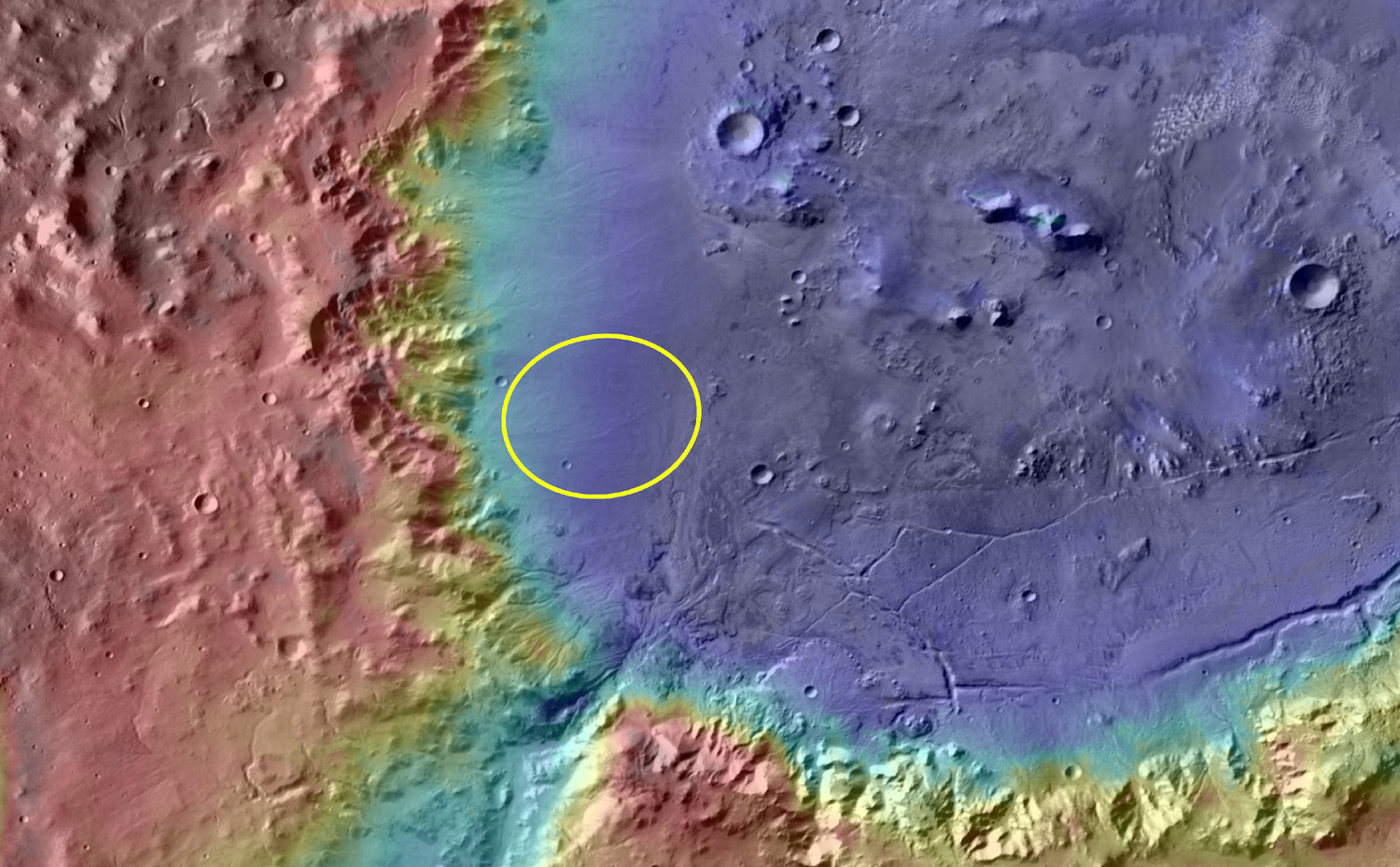
Holden Crater
February 15, 2009
Holden Crater
Credits
NASA/JPL-Caltech
ENLARGE
[51, 176]
Related
This series of images reconstructs the geology of the region around Mars' Mount Sharp, where NASA's Curiosity Mars rover landed and is now driving. The images, taken on Earth, have been altered for...
Sediment Accumulation in Dry and Wet Periods
Wispy clouds float across the Martian sky in this accelerated sequence of enhanced images taken on July 17, 2017, by the Navcam on NASA's Curiosity Mars rover.
Clouds Sailing Overhead on Mars, Enhanced
This image shows the robotic arm of NASA's Mars rover Curiosity with the first rock touched by an instrument on the arm.
Curiosity's Rock-Contact Science Begins
This video (part 1 of a 4 part series) shows engineers testing a new parachute in the largest wind tunnel on Earth for the Curiosity rover prior to its landing on August 2012.
The Martians: Testing Curiosity's Parachute - Part 1
A separate electronics box will allow the Mastcam to process images independently of the main rover computer system. Image credit: NASA/JPL-Caltech/MSSS
Mastcam Electronics
This full-resolution color image from NASA's Curiosity Rover shows the gravel-covered surface of Mars. It was taken by the Mars Descent Imager (MARDI) several minutes after Curiosity touched down o...
Gravel-Covered Martian Surface
Concretions at 'Cumberland'
Concretions at 'Cumberland' (Annotated)
This graphic maps locations of the sites where NASA's Curiosity Mars rover collected its first 19 rock or soil samples for laboratory analysis inside the vehicle. It also presents images of the dri...
Curiosity's Rock or Soil Sampling Sites on Mars, Through November 2016
This image shows the wall of a scuffmark NASA's Curiosity made in a windblown ripple of Martian sand with its wheel.
High-Resolution View of Cross-Section Through a Mars Ripple
This mosaic view from the Mast Camera (Mastcam) on NASA's Mars rover Curiosity shows textural characteristics and shapes of an outcrop called "Point Lake."
Puzzling 'Point Lake' Outcrop Revisited (White-Balanced, Unannotated)
The right Mast Camera (Mastcam) of NASA's Curiosity Mars rover provided this contextual view of the vicinity of the location called "John Klein," selected as Curiosity's first drilling site.
Diversity in Vicinity of Curiosity's First Drilling Target
This close-up image shows the first target NASA's Curiosity rover aims to zap with its Chemistry and Camera (ChemCam) instrument.
Curiosity's First Rock Star, Up-Close ANNOTATED
On Cape Canaveral Air Force Station in Florida, the payload fairing protecting NASA's Mars Science Laboratory (MSL) stands atop the 197-foot-tall United Launch Alliance Atlas V rocket, which is rea...
Mars Science Lab Atop Atlas V
This image shows the landing site of NASA's Curiosity rover and destinations scientists want to investigate.
Martian Treasure Map
This composite image, with magnified insets, depicts the first laser test by the Chemistry and Camera, or ChemCam,
First Laser-Zapped Rock on Mars
This video, presented at four times actual speed, shows a test using an engineering model of the soil scoop for NASA's Mars rover Curiosity. The scoop dips to about 1.4 inches (3.5 centimeters) dee...
Test Scooping for Mars Rover Curiosity
Curiosity is the biggest robot explorer ever to rove Mars. How do you power something like that?
Mars Rover Power
NASA’s Curiosity Mars rover used its Mastcam instrument to take the 126 individual images that make up this 360-degree panorama on March 3, 2021, the 3,048th Martian day, or sol, of the mission.
Curiosity's 360-Degree View Approaching 'Mont Mercou'
This image was taken inside a large 'clean room,' where ATLO (Assembly, Testing, and Launch Operations) is taking place for the Mars Science Laboratory mission. In the foreground on the right are e...
Keeping Time to a New Rover Beat
This view from NASA's Curiosity Mars Rover shows the downwind side of a dune about 13 feet high within the Bagnold Dunes field on Mars. The rover's Navigation Camera took the component images on De...
Slip face on Downwind Side of 'Namib' Sand Dune on Mars
The Sample Analysis at Mars (SAM) instrument for NASA's Mars Science Laboratory mission will study chemistry of rocks, soil and air as the mission's rover, Curiosity, investigates Gale Crater on Mars.
SAM Instrument at NASA Goddard Space Flight Center
While Curiosity continues to blaze a trail to Mount Sharp, the rover takes time to shoot a Martian moon movie.
The Odometer Keeps Turning
This image from the Mars Hand Lens Imager (MAHLI) on NASA's Mars rover Curiosity shows the patch of rock cleaned by the first use of the rover's Dust Removal Tool (DRT).
First Use of Mars Rover Curiosity's Dust Removal Tool
On ancient Mars, water carved channels and transported sediments to form fans and deltas within lake basins.
Chemical Alteration by Water, Jezero Crater Delta (Annotated)
This image shows the heatshield inside a large 'clean room'
One Hot, Giant "Clamshell"
You Might Also Like
The agency established the board in May 2023 to evaluate the technical, cost, and schedule plans prior to confirmation of the mission’s design.
NASA Releases Independent Review's Mars Sample Return Report
A pair of quakes in 2021 sent seismic waves deep into the Red Planet’s core, giving scientists the best data yet on its size and composition.
NASA InSight Study Provides Clearest Look Ever at Martian Core
Ten sample tubes, capturing an amazing variety of Martian geology, have been deposited on Mars’ surface so they could be studied on Earth in the future.
NASA's Perseverance Rover Completes Mars Sample Depot
Filled with rock, the sample tube will be one of 10 forming a depot of tubes that could be considered for a journey to Earth by the Mars Sample Return campaign.
NASA's Perseverance Rover Deposits First Sample on Mars Surface
The mission has concluded that the solar-powered lander has run out of energy after more than four years on the Red Planet.
NASA Retires InSight Mars Lander Mission After Years of Science
The 10 sample tubes being dropped on Mars’ surface so they can be studied on Earth in the future carry an amazing diversity of Red Planet geology.
NASA's Perseverance Rover to Begin Building Martian Sample Depot